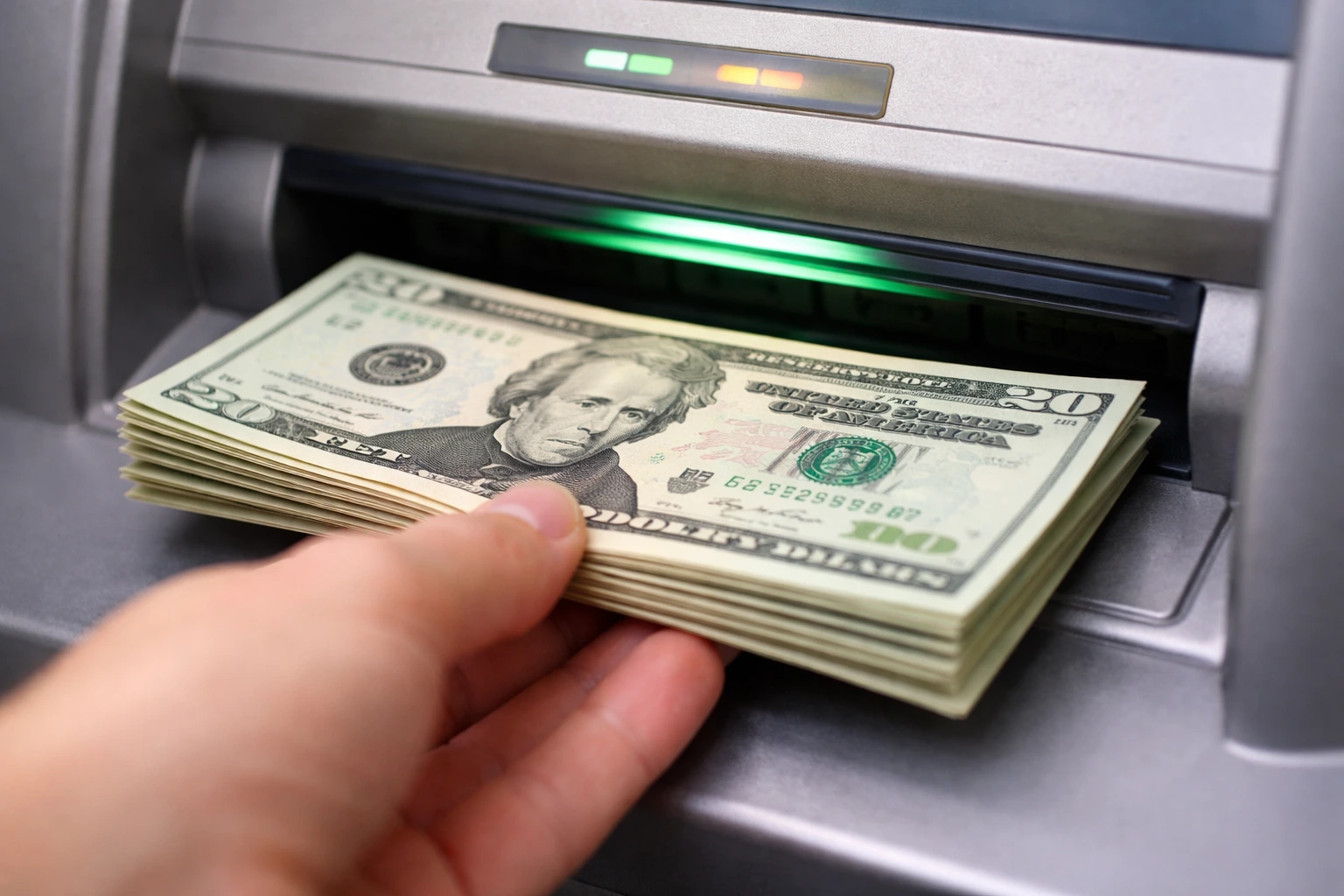
If you have ever withdrawn cash from an ATM, you have probably noticed that most machines dispense $20 bills instead of exact change. This is not random. ATMs are intentionally designed around $20 notes because they provide the best balance between machine capacity, security, servicing efficiency, and everyday withdrawal demand.
While some newer Smart ATMs now support multiple denominations, the $20 bill remains the standard across most ATM networks in the United States.
Quick Answer: Why Do ATMs Use $20 Bills?
- Storage efficiency: $20 bills let ATMs hold more total cash between service visits
- Demand match: Most common withdrawal amounts divide evenly into $20s
- Refill efficiency: Smaller bills deplete faster and require more armored carrier visits
- Security: Larger bills increase theft and fraud exposure per machine
- Simplicity: Single-denomination systems are easier to balance, service, and maintain
| Bill Type | ATM Efficiency | Why Banks Use It |
|---|---|---|
| $5 bills | Low | Require frequent refills and reduce cash capacity |
| $10 bills | Moderate | Useful for flexibility but less efficient than $20s |
| $20 bills | High | Best balance of demand, capacity, and servicing efficiency |
| $50 bills | Moderate | Useful for larger withdrawals but less practical for daily use |
| $100 bills | High | Maximizes dollar storage but increases fraud exposure |
How ATM Cash Cassettes Work
Inside every ATM are containers called cash cassettes. Each cassette stores only one denomination of bill and typically holds between 1,000 and 2,500 notes depending on the machine model.
Most ATMs contain two to four cassette slots, which means banks must decide carefully how to allocate denominations.
A common ATM cassette setup looks like this:
- Cassette 1: $20 bills
- Cassette 2: $20 bills
- Cassette 3: $20 bills
- Cassette 4: Optional — $10, $50, or $100 bills depending on branch configuration
Because most cassette space is dedicated to $20s, the machine maximizes total cash capacity while still serving the broadest range of withdrawal requests.
Some banks also dynamically adjust denomination availability based on withdrawal activity, remaining cassette inventory, branch traffic, and servicing schedules.
Supporting smaller bills like $5s or $10s requires dedicating cassette space to lower denominations that empty faster and reduce the machine’s total dollar capacity.
Why $20 Bills Became the ATM Standard
When modern ATM networks expanded during the 1970s and 1980s, banks needed a denomination that balanced storage efficiency with common withdrawal behavior. The $20 bill became the natural solution.
If ATMs were stocked primarily with $5 or $10 bills, machines would run out of cash much faster and require significantly more servicing by armored carriers. That increases operating costs and downtime.
- $20 bills satisfy most common withdrawal amounts efficiently
- They allow ATMs to hold more total dollar value per cassette
- They reduce armored carrier refill frequency
- They simplify ATM software and cash balancing systems
- They reduce maintenance and operational complexity
- The $20 bill is one of the most widely circulated denominations in the United States, making it the natural ATM default
For a full breakdown of ATM denominations, see What Bills Do ATMs Give? ($5, $10, $20, $50 & $100 Explained).
Why ATM Withdrawals Are Usually Multiples of $20
Most ATMs are loaded almost entirely with $20 bills, which means withdrawals must usually be requested in multiples of $20. A machine that contains only $20 bills physically cannot dispense $30 or $50 because those amounts require smaller denominations.
This is why ATM preset withdrawal buttons commonly show:
- $20
- $40
- $60
- $80
- $100
- $200
Even newer Smart ATMs that support denomination selection often default to $20 increments until you choose “Other Amount” or “Choose Bills.”
- $40 withdrawal → two $20 bills
- $100 withdrawal → five $20 bills
- $30 withdrawal → impossible on a $20-only ATM
- $50 withdrawal → impossible unless the ATM contains $10 or $50 bills
For more on withdrawal restrictions, see ATM Withdrawal Limits by Bank.
Why Smaller Bills Are Rare in ATMs
Smaller denominations such as $5 and $10 bills require more cassette space per dollar stored and deplete much faster than $20s. That creates operational problems for ATM operators.
A machine stocked heavily with $5 bills might require daily servicing, especially in high-traffic locations. For retail ATM operators, that extra servicing cost often outweighs the convenience benefit.
This is why smaller denominations are generally limited to newer bank-owned branch ATMs instead of gas station, convenience store, or standalone retail machines.
- $5 and $10 bills empty faster
- More service visits increase costs
- Retail ATMs prioritize simple high-volume withdrawals
- Branch ATMs are serviced more frequently and can support more flexibility
For more details, see ATMs That Dispense $5 Bills and ATMs That Give $10 Bills Near You.
The Security Factor: Why Not $50 or $100 Bills?
Larger bills such as $50s and $100s increase ATM dollar capacity, but they also increase theft and fraud exposure significantly.
A cassette loaded with $100 bills holds roughly five times the dollar value of the same cassette loaded with $20s. That makes the ATM a more attractive target for robbery, theft, and organized fraud operations.
Most ATM operators intentionally limit the amount of high-denomination cash stored inside standard machines to reduce financial exposure if the ATM is compromised.
High-capacity branch and business-district ATMs sometimes carry larger denominations, but those deployments usually involve additional security measures and higher servicing oversight.
How Modern ATMs Are Changing
Modern Smart ATMs are gradually adding more denomination flexibility. Many newer branch machines now support features such as “Choose Bills,” “Customize Cash,” or “Bill Mix.”
These machines often dedicate one cassette to alternative denominations while keeping most capacity in $20 bills.
- Some branch ATMs now support $10 withdrawals
- Select locations support $5 bills
- Business-focused ATMs may carry $50 or $100 bills
- Touchscreen Smart ATMs are more likely to support multiple denominations
- Retail and gas station ATMs still overwhelmingly dispense only $20s
To find compatible machines nearby, start with ATM Near Me — Find Bank-Owned ATMs Near You.
Real-World ATM Examples
Example 1 — Retail ATM: You attempt to withdraw $30, but the machine only dispenses $20 bills and forces a $40 withdrawal.
Example 2 — Smart branch ATM: You choose “Other Amount,” select “Choose Bills,” and withdraw one $10 bill and one $20 bill.
Example 3 — High-capacity downtown ATM: The ATM dispenses mostly $50 and $100 bills because the machine is optimized for larger business-district withdrawals.
Related ATM Guides
- What Bills Do ATMs Give? ($5, $10, $20, $50 & $100 Explained)
- ATMs That Dispense $5 Bills
- ATMs That Give $10 Bills Near You
- ATMs That Dispense $50 and $100 Bills
- ATM Withdrawal Limits by Bank
- ATM Near Me — Find Bank-Owned ATMs Near You
Bottom Line
ATMs dispense $20 bills because they provide the best balance of cash capacity, servicing efficiency, operational simplicity, security exposure, and withdrawal demand. While newer Smart ATMs are gradually adding more denomination flexibility, the $20 bill remains the most practical standard for most ATM operators and banks.
Frequently Asked Questions
Why do ATMs usually dispense $20 bills?
$20 bills balance storage capacity, refill efficiency, security exposure, and common withdrawal demand better than any other denomination.
Why can’t I withdraw $30 from an ATM?
If the ATM contains only $20 bills, it physically cannot assemble a $30 withdrawal because the machine does not have a smaller denomination available.
Can ATMs dispense $5 or $10 bills?
Some newer branch ATMs support smaller denominations, especially at Chase, PNC, Wells Fargo, and U.S. Bank locations.
Do any ATMs dispense $100 bills?
Yes. Some high-capacity branch ATMs in downtown and business-focused locations support $50 and $100 denominations.
Are ATMs moving toward more denomination options?
Yes. Many newer Smart ATMs now support denomination selection features such as “Choose Bills” and “Customize Cash.”
Why don’t ATMs use mostly $100 bills?
$100 bills dramatically increase theft and fraud exposure per machine, making standard ATMs more attractive criminal targets.
