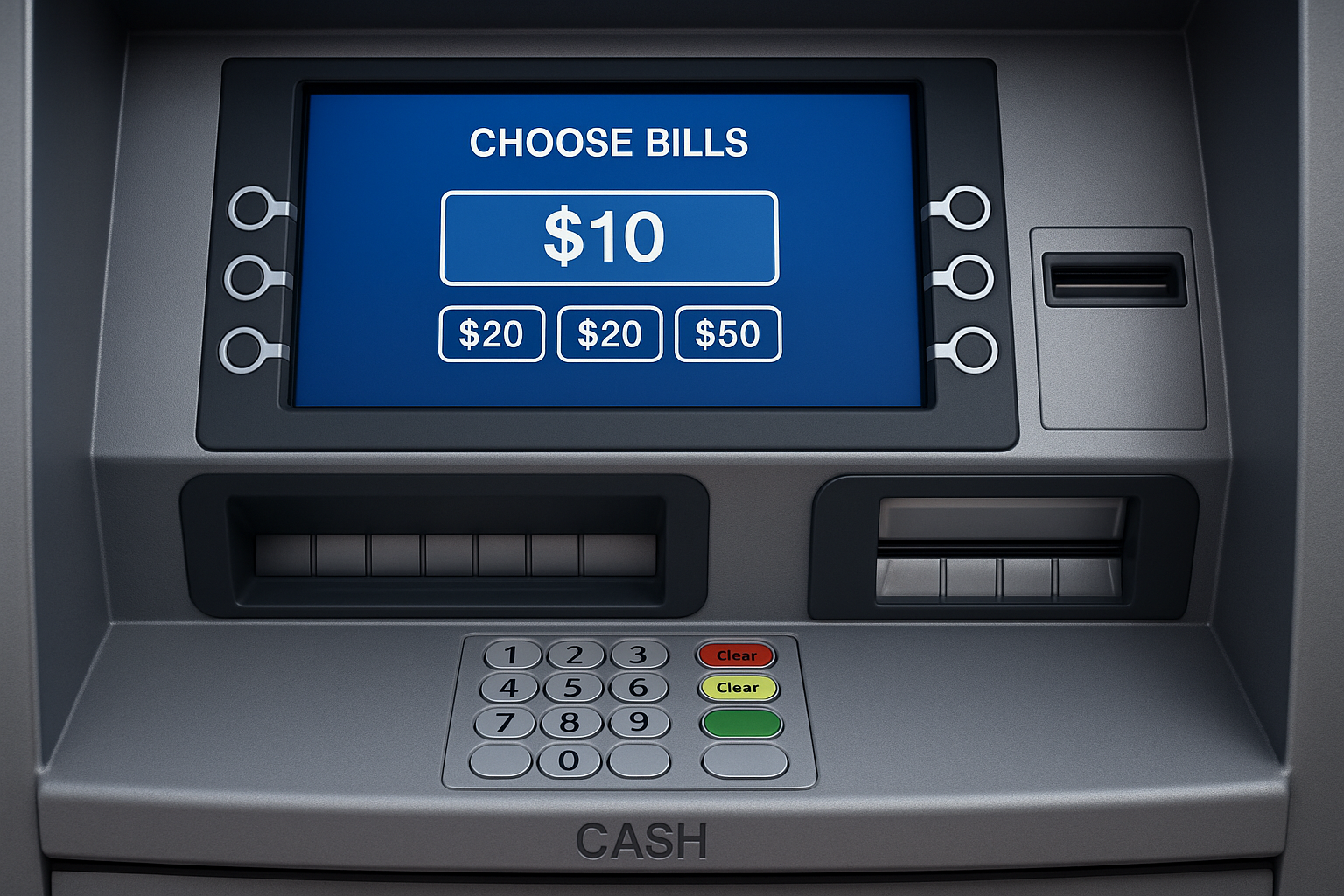
Yes — some ATMs allow you to withdraw $10 bills, but not every machine offers this option. Many older ATMs dispense only $20 bills, while newer branch-based machines often allow customers to choose smaller denominations such as $10.
If you need an ATM that gives $10 bills near you, your best chance is a modern bank branch ATM with features like Choose Bills or Customize Cash. These machines allow you to select the exact denominations you want, rather than receiving preset amounts.
Quick Answer
- Some ATMs dispense $10 bills, but most still default to $20 denominations.
- Older ATMs typically provide only $20 bills.
- Bank branch lobby ATMs are most likely to offer $10 withdrawals.
- Look for “Choose Bills” or “Customize Cash” options on the screen.
- Even compatible machines may temporarily run out of $10 bills.
Best Places to Try First for $10 Bill ATM Withdrawals
If you need $10 bills quickly, certain ATM locations are much more likely to offer denomination selection.
- Chase branch lobby ATMs
- PNC Bank ATMs with Customize Cash
- Wells Fargo full-service branch ATMs
- Large downtown bank branches
- Recently upgraded bank ATMs
Standalone ATMs at gas stations, convenience stores, and older retail locations typically dispense only $20 bills because they use simpler hardware and limited cash cassettes.
Banks Most Likely to Offer $10 Bill Withdrawals
Several major banks have upgraded portions of their ATM networks with machines capable of dispensing multiple denominations. Availability varies by specific branch and machine configuration.
| Bank or Network | $10 Bill Availability | Machine Type |
|---|---|---|
| Chase | Yes (select branches) | Smart ATMs with denomination selection |
| PNC Bank | Yes | Customize Cash machines |
| Wells Fargo | Yes (many upgraded ATMs) | Multi-denomination ATMs |
| Bank of America | Limited | Full-service branch ATMs |
| US Bank | Limited | High-volume branch machines |
| Allpoint / MoneyPass | Varies | Operator dependent |
Where to Find ATMs That Dispense $10 Bills
If you are searching for an ATM that dispenses $10 bills near you, the machine’s location matters. Certain ATM types are far more likely to support multi-denomination withdrawals.
- Bank branch lobby ATMs
- Downtown banking districts
- University campus banking centers
- Airports and transit hubs
- Recently upgraded branch ATMs
If you need help locating a compatible machine, our ATM Near Me guide explains the easiest ways to find nearby ATMs using bank locators and ATM network maps.
What Bill Denominations Do ATMs Usually Dispense?
Most ATMs still dispense $20 bills by default, but newer machines may also provide other denominations depending on their configuration.
- Most common: $20 bills
- Sometimes available: $10 bills
- Less common: $5 bills
- Select machines: $50 and $100 bills
If you need a different bill size, you may also want to see our guides on ATMs that dispense $5 bills and ATMs that dispense $50 and $100 bills.
Why Most ATMs Still Dispense $20 Bills Only
Many ATMs were originally designed with limited internal cash cassettes. Each cassette holds a single denomination of currency, and banks typically prioritize $20 bills because they balance convenience and storage efficiency.
- Additional cassette slots are required for smaller denominations
- Smaller bills require more frequent cash replenishment
- Machines must support denomination selection software
- Smaller bills deplete faster in high-traffic locations
How to Tell If an ATM Dispenses $10 Bills
You can usually determine whether an ATM supports $10 withdrawals during the withdrawal process.
- Select Other Amount instead of preset withdrawal buttons
- Look for a Choose Bills or Customize Cash option
- Check if the ATM displays denomination choices
- Use bank ATM locators to find upgraded machines
What to Do If an ATM Will Not Give You $10 Bills
- Try selecting “Other Amount” instead of preset withdrawal buttons
- Look for denomination selection options
- Try another ATM at the same bank branch
- Use a bank-owned ATM instead of a retail ATM
- Withdraw during branch hours when machines are freshly stocked
Why an ATM That Supports $10 Bills Might Still Dispense $20s
- The $10 bill cassette is temporarily empty
- The ATM entered cash conservation mode
- Preset withdrawal buttons override custom bills
- The ATM operator disabled mixed denominations
- High demand depleted smaller bills earlier in the day
Frequently Asked Questions
Can I withdraw exactly $10 from an ATM?
Yes, but only at ATMs that support multi-denomination withdrawals. Most traditional ATMs require withdrawals in $20 increments.
Which banks have ATMs that give $10 bills?
Many upgraded ATMs at banks such as Chase, PNC, and Wells Fargo support $10 withdrawals, though availability varies by machine and location.
Why won’t an ATM give me $10 bills?
The ATM may not be configured for $10 notes, or the $10 bill cassette may be empty.
Can convenience store ATMs dispense $10 bills?
Most convenience store ATMs dispense only $20 bills because they use simpler hardware and smaller internal cash capacity.
What bill denominations do ATMs usually dispense?
Most ATMs dispense $20 bills by default. However, modern bank branch ATMs may also provide $10, $50, or $100 bills depending on the machine configuration and how the ATM is stocked.
- Most common denomination: $20 bills
- Sometimes available: $10 bills
- Less common: $5 bills
- Select machines: $50 and $100 bills
If you need a specific bill size, see our guides on ATMs that dispense $5 bills and ATMs that dispense $50 and $100 bills.
