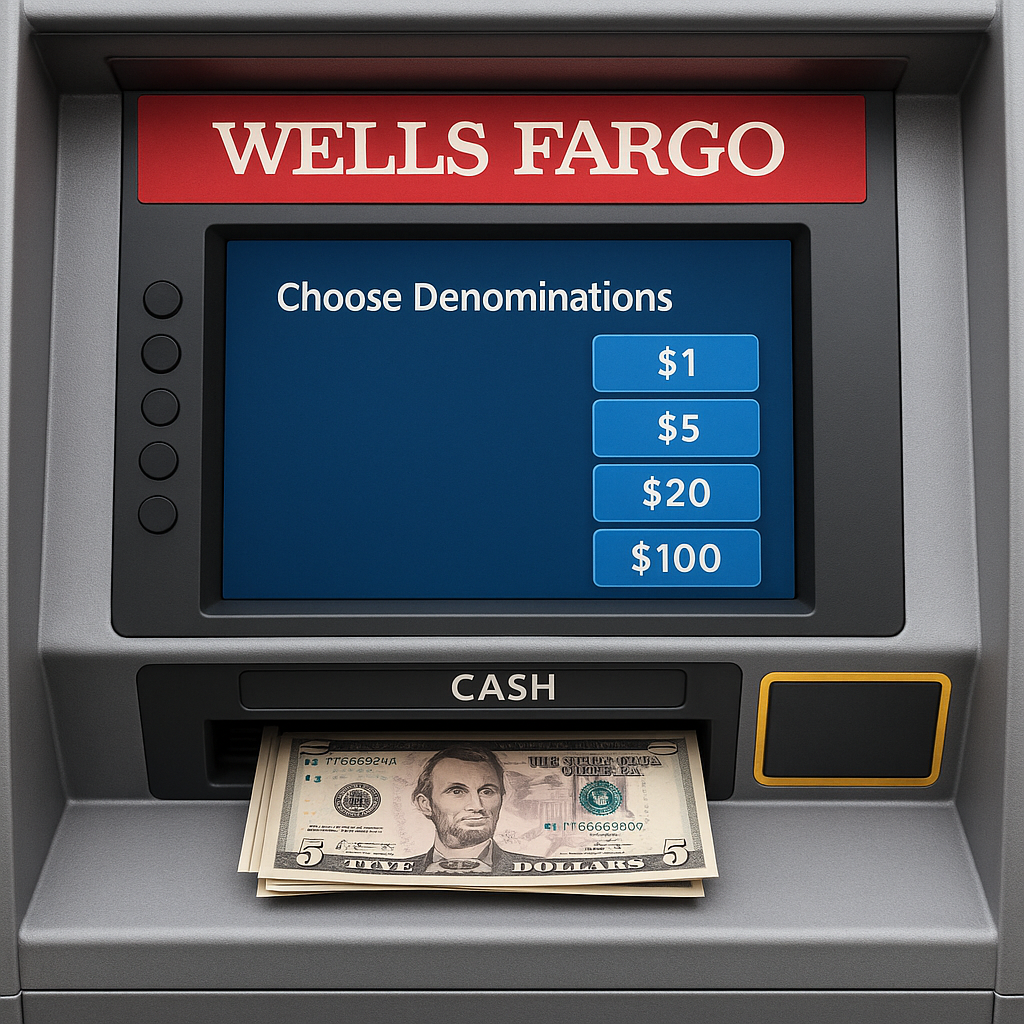
Most ATMs still default to dispensing $20 bills, but some newer machines now support smaller denominations — including $5 bills. Whether you can withdraw $5 notes depends less on the bank brand and more on how the individual ATM is configured and stocked.
If you are trying to find an ATM that dispenses $5 bills, your best chance is a modern branch ATM with multi-denomination support. These machines allow customers to choose specific bill types instead of receiving only preset withdrawal amounts.
Quick Answer
- Some upgraded ATMs dispense $5 bills, but many still do not
- Branch lobby ATMs are most likely to offer $5 withdrawals
- Older ATMs usually dispense only $20 bills
- Look for “Choose Bills” or “Customize Cash” options on screen
- Availability depends on cassette configuration and stocking
Why Most ATMs Do Not Stock $5 Bills
ATMs use internal cash cassettes, and each cassette holds a single denomination. Many older machines only support two or three cassette slots, which forces banks to prioritize certain bill types.
$5 bills are often avoided because they:
- Deplete faster than larger denominations
- Require more frequent replenishment
- Reduce the total cash capacity inside the machine
- Increase balancing and handling complexity
Because of this, many ATM operators prioritize $20 and $100 bills. As a result, $5-bill ATMs are usually found at newer or recently upgraded branch locations.
How ATM Cassette Configuration Determines Availability
Inside every ATM are multiple cash cassettes. Each cassette holds one denomination, and the bank decides how those slots are used.
A common multi-denomination ATM configuration might look like this:
- Cassette 1: $20 bills
- Cassette 2: $20 bills
- Cassette 3: $100 bills
- Cassette 4: Optional ($10 or $5 bills)
If the fourth cassette is assigned to $10 bills instead of $5 bills, the ATM will not dispense $5 notes even if the machine hardware technically supports them.
Banks Most Likely to Offer $5 Bill Withdrawals
Availability varies by location, but the following banks have deployed upgraded ATMs capable of dispensing multiple denominations, including $5 bills at select branches.
| Bank or Network | $5 Bill Availability | Machine Type |
|---|---|---|
| Chase | Yes (select branches) | Smart ATMs with denomination selection |
| Wells Fargo | Yes (upgraded locations) | Multi-denomination ATMs |
| PNC Bank | Yes | Customize Cash machines |
| Bank of America | Limited | Full-service branch ATMs |
| US Bank | Limited | Urban branch locations |
| Allpoint Network | Varies | Operator dependent |
Why a $5-Capable ATM May Still Dispense Larger Bills
Even if a machine technically supports $5 bills, you may still receive larger denominations during a withdrawal.
- The $5 cassette is temporarily empty
- The ATM activates cash conservation mode
- Preset withdrawal buttons override custom selection
- Mixed denomination withdrawals are disabled
- The bank restricts small bills during high demand
Using the “Other Amount” option during a withdrawal often reveals whether the machine currently allows denomination selection.
Where $5-Bill ATMs Are Most Common
- Recently upgraded bank branch lobby ATMs
- Downtown financial districts
- College campuses
- Busy urban retail corridors
- Airports and transit hubs
Standalone convenience store ATMs and older drive-up machines rarely support $5 withdrawals because of hardware and stocking limitations.
How to Improve Your Chances of Finding One
- Use branch lobby ATMs instead of outdoor machines
- Look for “Smart ATM” or “Full-Service ATM” labels
- Check your bank’s official ATM locator
- Select a custom withdrawal amount instead of preset buttons
- Visit during business hours when branch machines are accessible
Fees and Small Withdrawals
Withdrawing very small amounts can sometimes trigger unnecessary ATM fees, especially at out-of-network machines.
- Use surcharge-free ATM networks
- Withdraw mixed denominations in one transaction
- Choose banks that reimburse ATM surcharges
- Use cash-back at checkout when available
Key Takeaway
ATMs that dispense $5 bills do exist, but they remain relatively uncommon. Your best chance is a newer bank branch ATM with multi-denomination support. Always check for “Choose Bills” or denomination selection on the screen before completing your withdrawal.
